



Table Of Contents:
From File Chaos to Logical Organization
Optimized Storage for Query Performance
Intelligent Search Across Your Organization
From Discovery to Analysis Without Friction
Collaborative Discovery at Scale
Intelligence Built Into Every Layer
Watch the Video: From Search to Insights with TileDB Carrara
You need that single-cell dataset from last week. Or was it two weeks ago? Your blob storage is a maze of auto-generated filenames from different systems and pipelines. Without metadata or logical organization, finding the right dataset means opening files one by one, hoping you stumble upon what you're looking for.
This data archaeology wastes hours of valuable research time. Adding metadata to files in traditional blob storage requires copying or overwriting existing data, which is inefficient and costly, especially for large genomics files.
TileDB Carrara transforms data discovery by treating your cloud storage as an intelligent, searchable catalog. What used to take hours of hunting now takes seconds with logical organization, rich metadata, and powerful search capabilities that understand scientific data.
From File Chaos to Logical Organization
Carrara provides logical organization and descriptive metadata to your raw data in cloud storage, enabling you to browse thousands or millions of datasets and find what you need in seconds. The platform doesn't just store files, it understands them.
Built-in previews work with common data types, including structured array data, bioimaging groups, CSVs, interactive HTML reports, PDFs, notebooks, JSON, text files, and more. Choose a file to see relevant information without opening it. Every file shows when it was last modified and by whom.
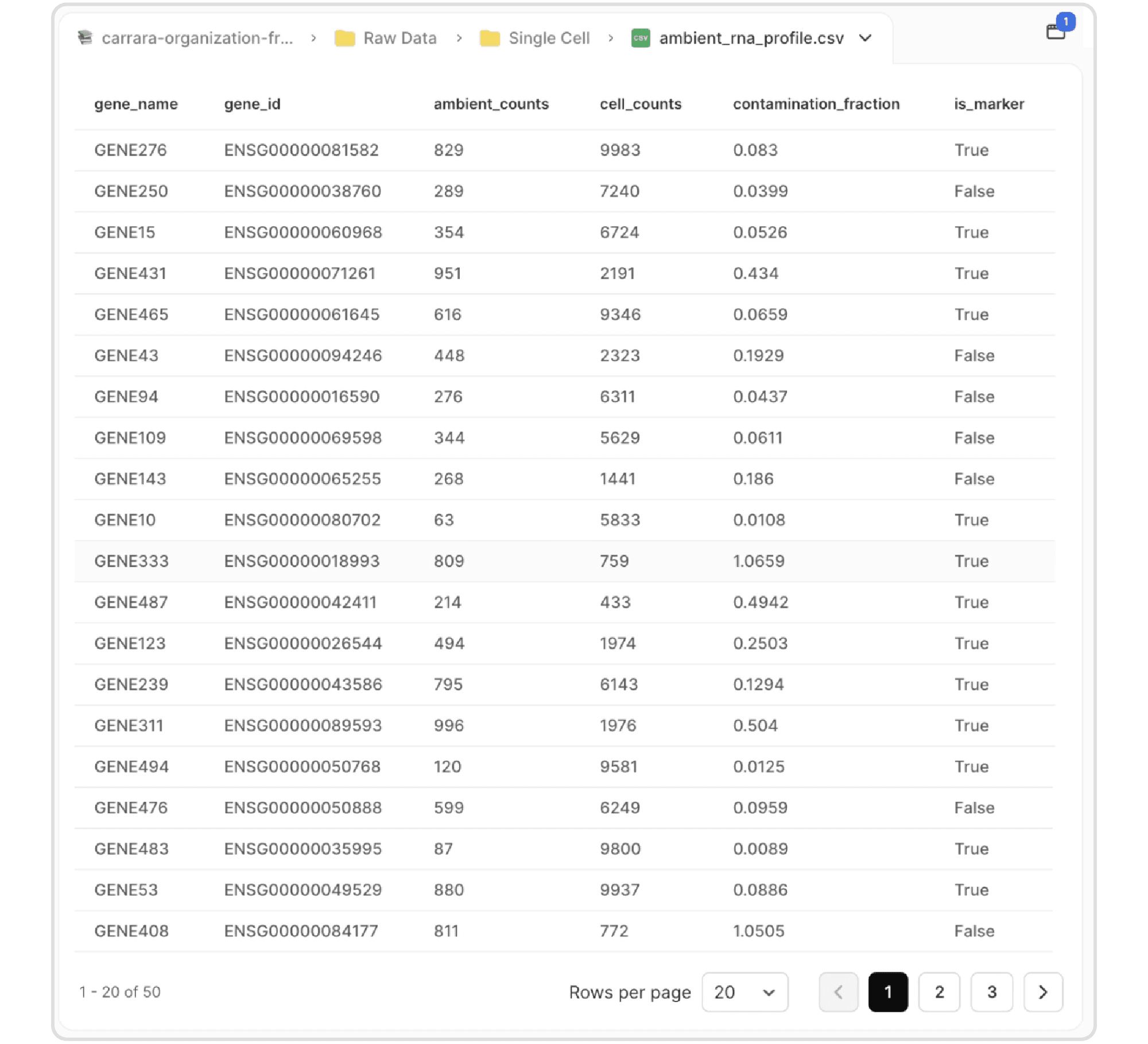
In this Teamspace in TileDB Carrara, you can see metadata without opening the file.
Assets can be enriched with arbitrary metadata, whether system-generated or user-added. You can edit filenames and add descriptions directly in Carrara. This flexibility supports easier tracking and discoverability of key information, regardless of how large your catalog grows.
Optimized Storage for Query Performance
When you need to optimize raw data for storage efficiency or query performance, Carrara handles the transformation. Single-cell data becomes TileDB-SOMA. Population genomics data becomes TileDB-VCF. Even imaging data becomes instantly queryable through TileDB's multi-dimensional array architecture.
These optimized formats live alongside your raw files in the same unified catalog, maintaining governance and making both original data and analysis-ready formats equally discoverable.
Intelligent Search Across Your Organization
Need to find that analysis from last week? Simple filters inside your Teamspace help you locate exactly what you were working on. But Carrara's search power extends far beyond your own files.
Expand your search across the entire workspace to discover what colleagues are working on. Combine text search with Boolean operators and filter by any metadata field. Need specific experimental conditions? Query metadata conditionally: cell count ranges, QC status, tissue type, or any custom metadata your team uses.
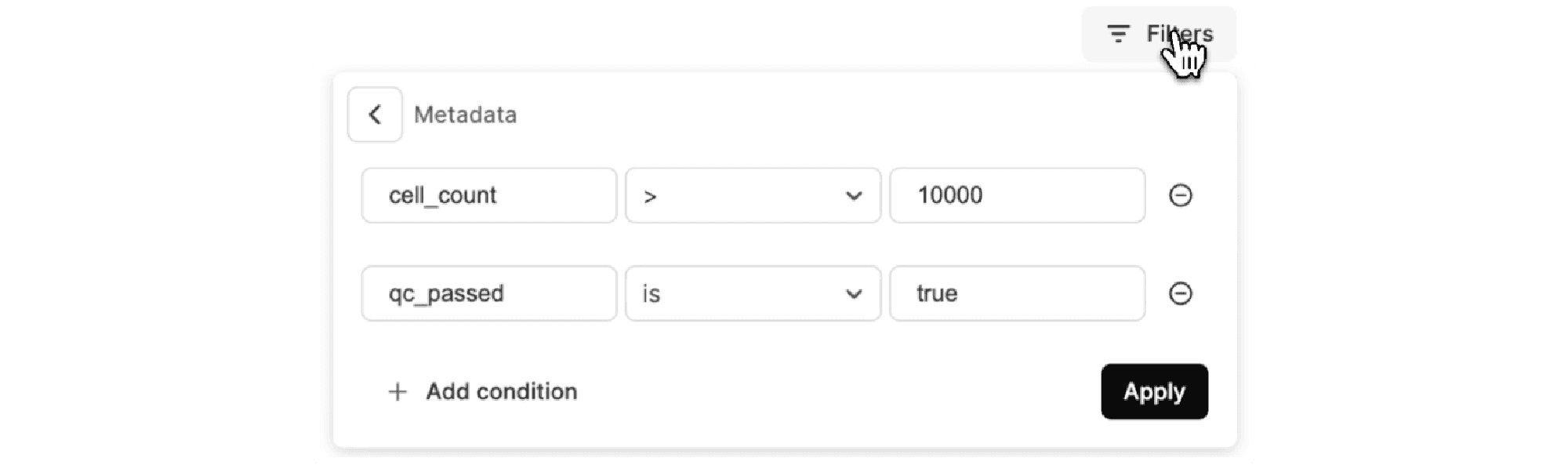
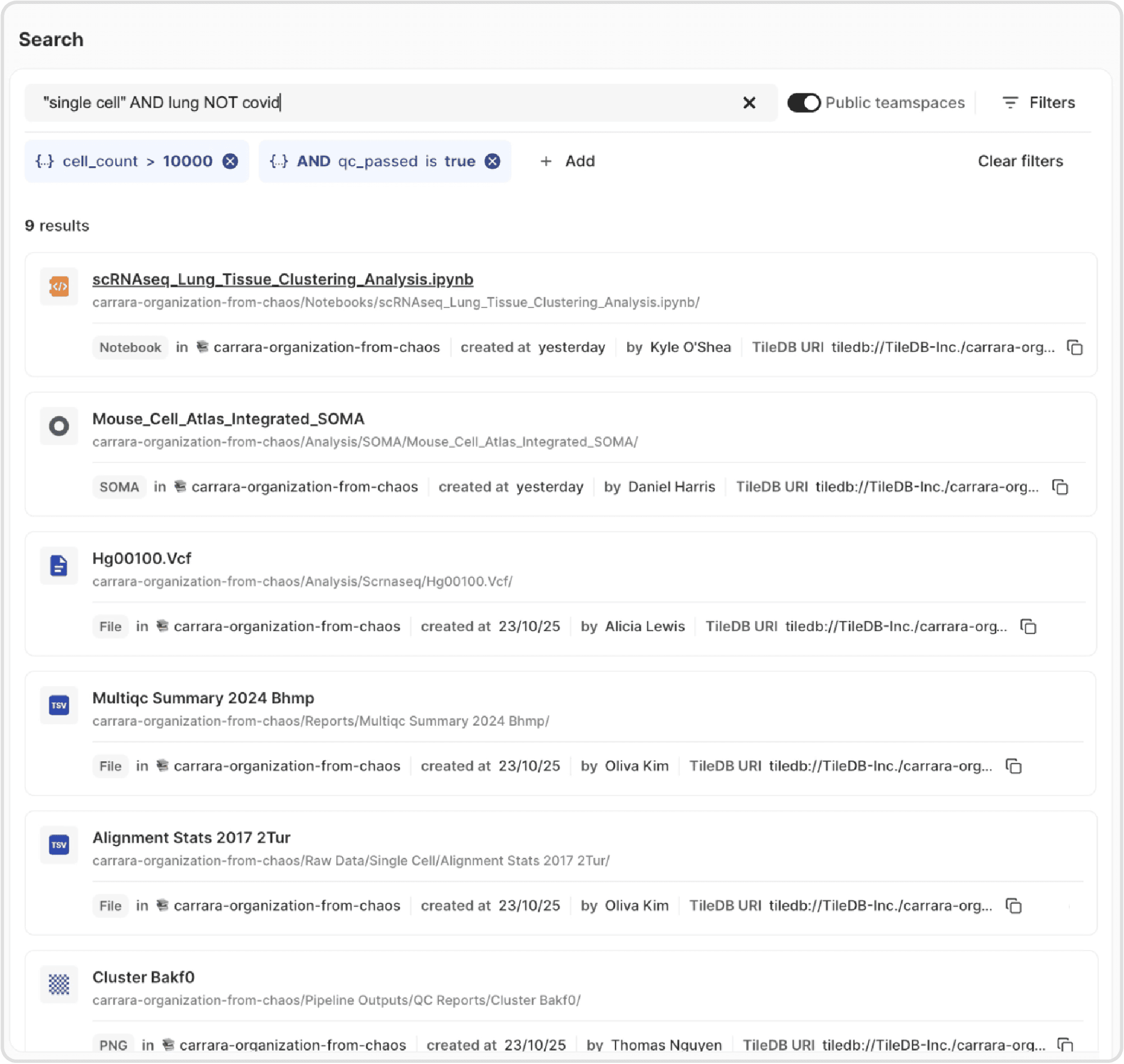
With TileDB Carrara, you can combine text search with Boolean operators to filter by any metadata field so you find files with relevant information faster.
Every keystroke refines your search with real-time results. You can stop waiting for queries to run, because you can watch results evolve as you type. Your search returns everything: raw files, structured data formats, analysis notebooks, and every other asset in your catalog, all from one query.
From Discovery to Analysis Without Friction
You can click any search result to dive deeper. Browse assets, view metadata, and examine schemas without downloading anything. When you discover a colleague has created a SOMA object from raw data generated by your team's pipelines, you can build on their work instead of starting from scratch.
Using search in TileDB Carrara, you can find a colleague’s SOMA object from raw data generated by the team’s pipelines. This capability makes it possible for you to build on their work instead of starting from scratch and discover unexpected connections in data.
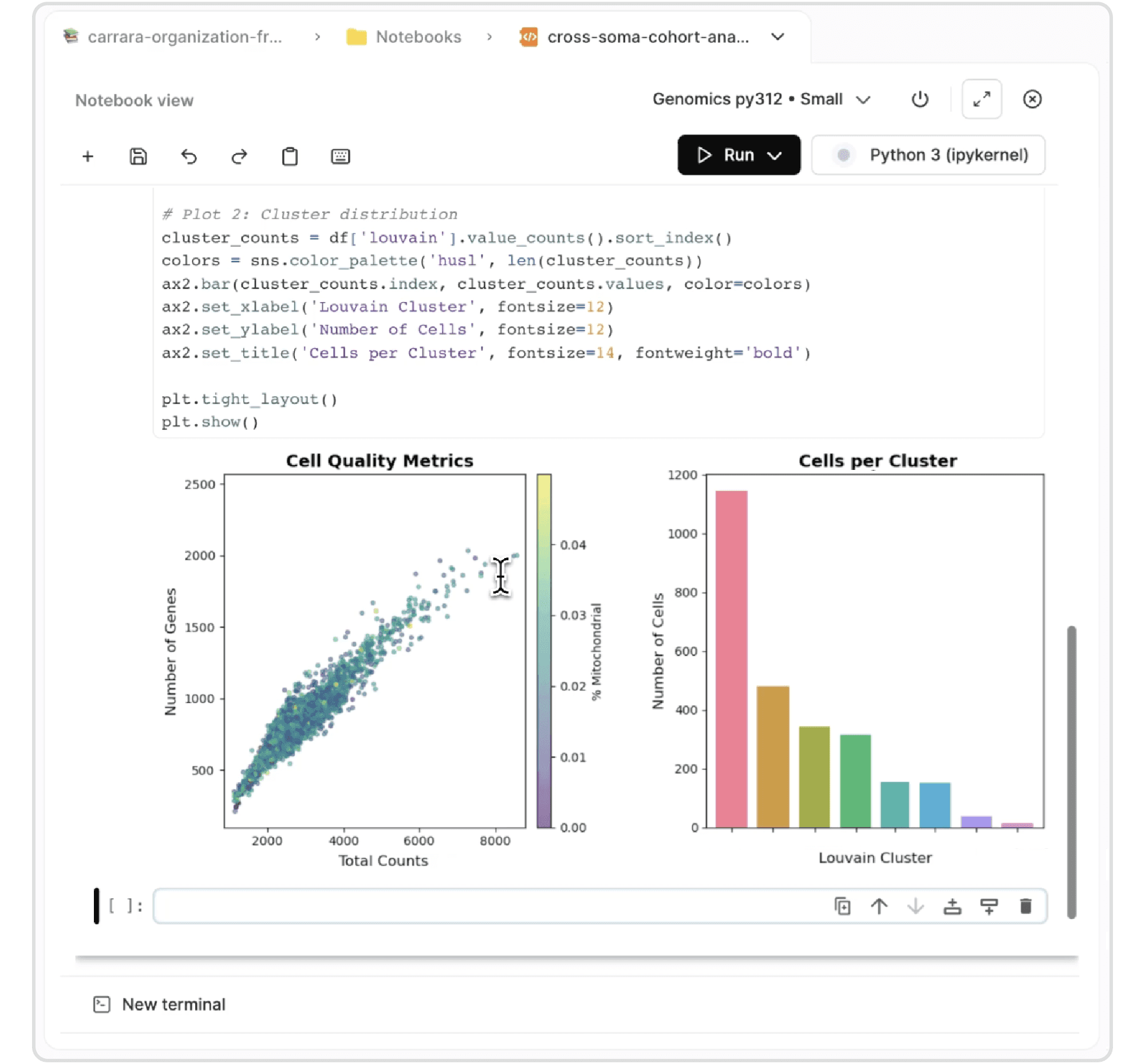
Catalogued objects can be referenced directly from notebooks. Visualize insights right in the catalog, alongside your data, where analysis can be reused, extended, or combined with other datasets in your Teamspaces.
This integrated approach eliminates the context switching that plagues traditional research workflows. Scientists no longer jump between blob storage browsers, metadata databases, notebook environments, and visualization tools. Everything happens in one unified platform.
Collaborative Discovery at Scale
What started as a simple search becomes true discovery. Find unexpected connections between datasets across your organization. A keyword search for a specific gene might surface relevant imaging data from a different team. A metadata filter for tissue type might reveal complementary experiments you didn't know existed.
From search to analysis in under a minute. This is how modern scientists should work with data. No more data archaeology. No more lucky guesses. Just fast, intelligent search that connects you to the insights you need.
Intelligence Built Into Every Layer
Carrara's search capabilities work because the platform understands scientific data at every layer. Automatic metadata extraction from common file formats. Rich previews that show what matters for each data type. Real-time indexing that keeps pace with new data. And schema-aware search that understands the structure of complex scientific data formats.
The result is a research environment where data discovery happens naturally, collaboration flows seamlessly, and insights emerge faster. Teams spend less time hunting for data and more time generating discoveries.
Ready to unlock intelligent data search? Discover how TileDB Carrara can transform your research workflow and eliminate data archaeology from your daily routine.
Meet the authors

Kyle O'Shea
Senior Product Manager